


14/07/2026
Teatro di San Carlo in Naples
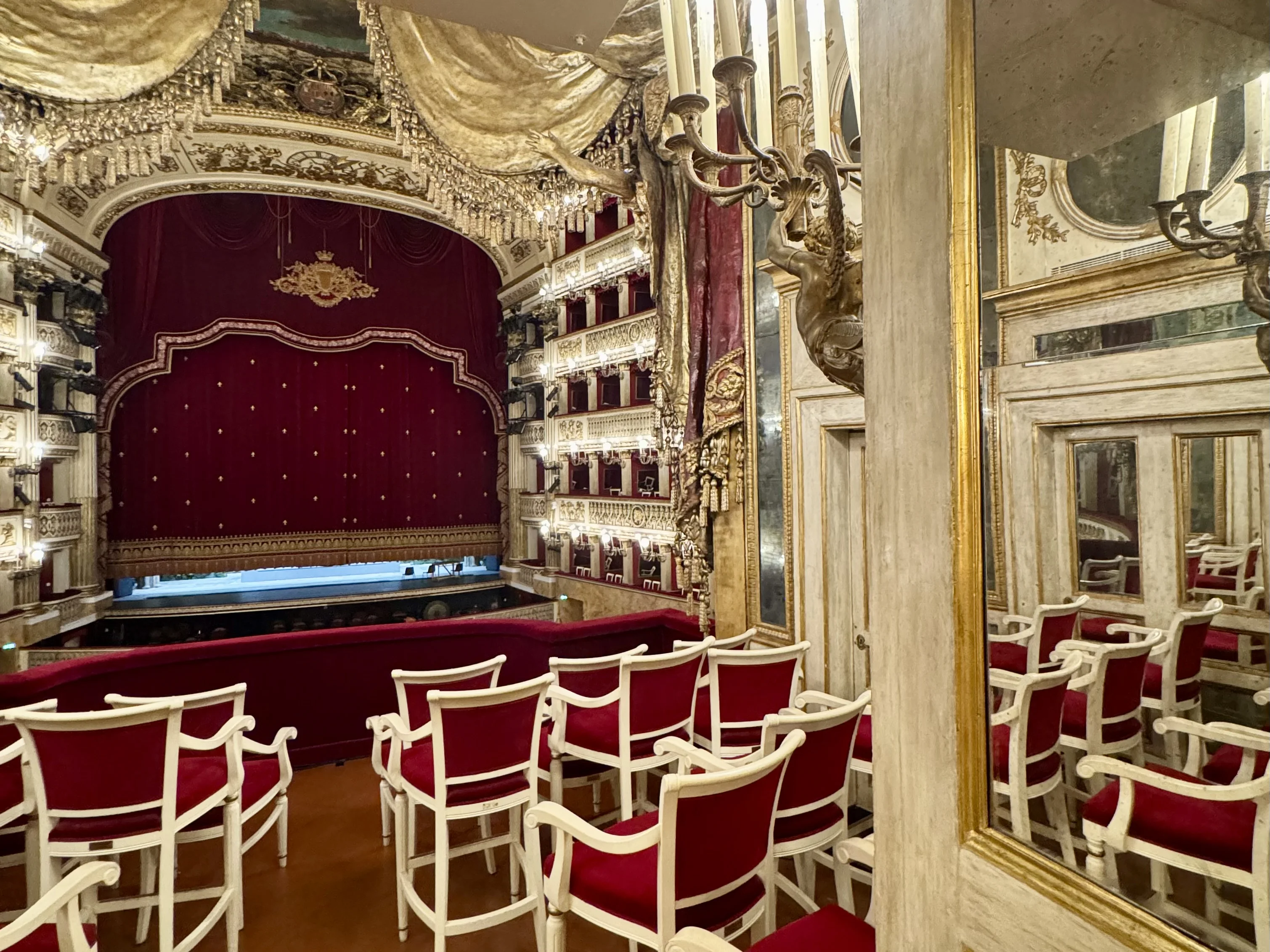
Ten days later. And I’m still in the Royal Box.
Some places you leave as soon as the door closes behind you. Others you take home with you.
Ten days ago, I was at the Teatro di San Carlo in Naples. Since then, this experience has stayed with me – not because of a single aria or a particularly spectacular production, but because of the theatre itself. I keep catching myself thinking:
Who on earth has stood here before?
What voices have filled this stage? Which great singers have trembled, cheered or celebrated triumphs here? Who took a deep breath behind the heavy velvet curtain before it rose?
And then my thoughts wander up to the boxes.
Who might have sat in the magnificent Royal Box over the centuries? Which queens, kings, state guests or artists have looked down onto the stage from there? And who, in turn, observed the royal family – quite discreetly, of course – through the mirrors mounted on the walls, from the side boxes? Who captured their applause, their gestures, their conversations? I find this thought fascinating.
An opera house is far more than just a building.
An opera house is a silent yet very much living witness to centuries of music, stories and encounters.
The Teatro di San Carlo opened as early as 1737 and is considered the oldest opera house still in operation in the world.
Following a devastating fire in 1816, it was rebuilt in just nine months. It opened 41 years before La Scala in Milan and 55 years before the
Teatro La Fenice in Venice, and influenced the architecture of many opera houses subsequently built throughout Europe.
As I looked out into the auditorium, I suddenly understood why.
The horseshoe-shaped auditorium, the six tiers of boxes stacked one above the other, the brilliant red of the velvet, the opulent gold ornamentation and, of course, the magnificent Royal Box – all of this seems almost self-evident today. Yet much of it was realised here with a level of perfection that later became the model for numerous opera houses. Anyone who has ever been to Italy, Austria or even some of the historic theatres of South America will repeatedly discover familiar elements. Somehow, a little piece of the San Carlo seems to resonate everywhere.
I was particularly fascinated by the boxes.
Not only the elegance of each individual box, but also the mirrors. They were by no means merely decorative. It is said that they allowed one to discreetly glance towards the royal box without having to turn one’s head. Who was present? Who was applauding? Which guests had come? That, too, was part of the social occasion of an opera evening back then.
People make history at the opera house
How many premieres might these walls have witnessed?
Rossini presented his first opera, „Elisabetta, regina d’Inghilterra“, at the San Carlo in 1815. Donizetti wrote 17 works for the theatre, including „Lucia di Lammermoor“, which premiered here in 1835. Bellini made his debut in 1826 with „Bianca e Gernando“,
whilst Verdi’s „Luisa Miller“ had its world premiere at the San Carlo in 1849.
Later, world-famous stars such as Enrico Caruso, Maria Callas, Luciano Pavarotti and Plácido Domingo graced this stage.
And then I find myself wondering once again: what stories lie hidden amongst all these famous names? Which young singers, overcome with stage fright, stepped onto this stage for the very first time? Which audience members left the theatre with tears in their eyes, having just experienced an unforgettable evening?
For me, it is precisely these thoughts that make a place unforgettable.
Not just the architecture, not just the music, but the realisation that you have become part of a long history. For a single evening, you sit in a seat that countless people before you have occupied. You hear music in a space where it has been played for almost three centuries.
And suddenly it dawns on you: you’re not just attending an opera, but experiencing a piece of living cultural history.
When I think of Naples today, I naturally think of the sea, the aroma of a freshly brewed espresso, the light over Vesuvius and the narrow alleyways of the old town. But I also think of the hours I spent at the Teatro di San Carlo.
Ten days have passed.
And I still find myself wondering what stories this opera house would tell if its red velvet curtains could speak.
For me, a visit to the Teatro di San Carlo is one of the most memorable cultural experiences in Europe. And the best thing about it is that it can be wonderfully combined with the many other treasures of the Gulf of Naples – the elegant streets of Sorrento, the colourful houses of Procida, the wild beauty of Ischia, or a trip along the Amalfi Coast.
Here you’ll find our current music tour to Naples, featuring a visit to the Teatro di San Carlo to see an opera.
About the author
Jürgen Mamczek is the owner and founder of Music Travel Hideaways and has been working in the tourism industry for over 30 years.
He knows many of the concert venues, hotels and destinations he recommends from personal experience.
He visited the Teatro di San Carlo in Naples in the summer of 2026.
